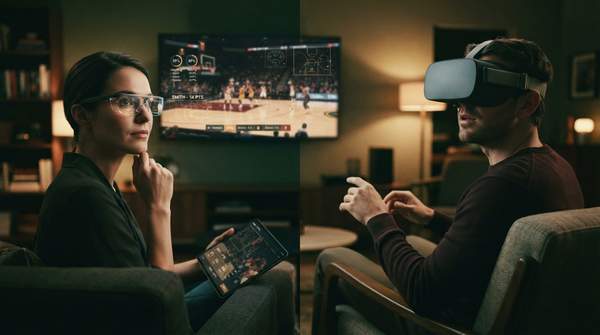
Augmented reality and virtual reality are changing how fans watch live sports, but they are not doing the same job. AR keeps you in the real world and layers digital information on top of it—real-time statistics, player details, virtual field markings and sponsor graphics delivered through the phone in your pocket. VR does the opposite: it replaces the real world entirely, placing you inside a simulated stadium through a dedicated headset. Understanding that distinction is the key to knowing what each technology actually offers you as a viewer.
Introduction: Transforming Sports Viewing with AR and VR
Both technologies have moved from novelty to broadcast strategy. Altman Solon's 2022 Global Sports Survey found fan interest in using AR and VR for sports, and reported that many leagues and teams are embracing the technologies to grow reach and engagement. The consulting firm frames AR and VR as forces "poised to change the way fans engage with sports," from AR overlays during live broadcasts to watching NBA and English Premier League games in virtual reality. The two paths, however, serve different fan desires: one enriches the broadcast you already watch, while the other builds a new place to watch it from.
Augmented Reality: Enhancing the Real-World Broadcast
AR works by augmenting, not replacing, your view of the game. As HQSoftware describes in its overview of AR/VR for sports, augmented reality enhances the live viewing experience by overlaying real-time statistics and player information, virtual field markings and explanatory graphics, and sponsor advertisements onto the broadcast. The result, according to the company, is a viewing experience that is more engaging and informative—whether you are watching from home or from inside the stadium.
Crucially, AR meets fans where they already are. Altman Solon notes that AR overlays can engage a mobile-first viewing public while giving teams new sponsorship opportunities, which is one reason broadcasters find the technology commercially attractive. The fan does not need to disappear into another world; they need only glance at a second screen while the game unfolds.
Virtual Reality: Immersive New Worlds for Sports Fans
VR takes the opposite approach: it transports the viewer somewhere else. HQSoftware describes VR platforms for live sports as offering 360-degree views, multiple camera angles and interactive features that let viewers feel as if they are in the stadium, enhancing the at-home experience. Beyond live games, the company notes that fans use VR for immersive viewing and virtual stadium tours.
The scale of real-world adoption is worth noting. According to Altman Solon's reporting, the NBA was broadcasting one to two games per week in VR, while the English Premier League and World Wrestling Entertainment had both partnered with Meta to provide VR viewing experiences. The same firm's survey findings suggest this is more than experimentation: in China, 66% of sports fans said they would be willing to pay to watch a game in VR, and most fans surveyed would pay to attend events virtually.
AR vs. VR: A Fan's Guide to Enhanced Sports Viewing
The clearest way to see the difference is side by side. The table below contrasts the two technologies across the dimensions that matter most to a viewer: what the technology does, what the experience feels like, what fans actually use it for, and what hardware it demands.
| Dimension | Augmented Reality (AR) | Virtual Reality (VR) |
|---|---|---|
| Technology Type | Overlays digital information onto the real-world view; enhances the existing environment rather than replacing it | Creates a fully immersive, simulated environment that replaces the real world, transporting the viewer to a virtual space such as a stadium |
| User Experience | An enhanced view of the real broadcast with interactive data and graphics, suited to a mobile-first audience | A 360-degree, multi-angle, interactive presence within a virtual stadium or game, with the feeling of being physically at the event |
| Example Applications for Fans | Real-time statistics and player information, virtual field markings, explanatory graphics and sponsor advertisements during live games | Virtual stadium tours, immersive live game broadcasts and interactive virtual fan experiences, offered by leagues including the NBA, EPL and WWE |
| Typical Hardware | Mobile devices such as smartphones and tablets | Dedicated VR headsets that block out the real world for full immersion |
Read down the columns and the pattern emerges: AR is an additive technology bolted onto viewing habits you already have, while VR is a substitutional one that asks you to trade your living room for a virtual seat. Neither is a strict upgrade over the other; they answer different questions about what a fan wants from a broadcast.
Impact on Fan Engagement and Broadcast Storytelling
For engagement, the two technologies pull in complementary directions. AR deepens the informational layer of a broadcast, turning passive watching into data-rich interpretation—a viewer can see why a play worked while it is happening. VR widens the experiential layer, collapsing the distance between a fan in one country and a stadium in another, whether through live games, virtual fan events or stadium tours.
There is also a shared commercial logic. Altman Solon argues that these technologies provide new ways to monetize sports assets and intellectual property, with AR creating new sponsorship inventory and VR representing what the firm calls a future revenue stream, given surveyed fans' willingness to pay for virtual attendance. Leagues' adoption of both suggests the industry sees engagement and monetization as two sides of the same investment.
Deciding Your Next-Generation Sports Experience
Fans can choose between AR for an enhanced, interactive overlay on their existing view or VR for a fully immersive, virtual presence at sporting events, depending on their preference for augmentation versus complete immersion. The practical dividing line is hardware and intent: AR fits the fan who watches with a phone or tablet in hand and wants statistics, graphics and player context layered onto the game they are already seeing, while VR fits the fan willing to put on a dedicated headset in pursuit of a 360-degree, in-stadium sensation.
The measurable indicator of which path suits you is the fan's choice of viewing hardware—smartphone or tablet for AR, dedicated headset for VR—and the type of interactive or immersive features they prioritize. If you find yourself pausing to check a player's numbers mid-match, AR's overlay model is built for you; if your goal is to feel present at a game an ocean away, the VR offerings already deployed by the NBA, Premier League and WWE are the place to start.
Sources
- AR/VR: Key for sports fan engagement and monetization — Altmansolon
- AR VR for sports — HQSoftware