Soccer's Video Assistant Referee and the NFL's instant replay system both use video to correct officiating mistakes, but they are built on opposite assumptions about who should be trusted to spot the error. In soccer, a dedicated team of video officials watches every play proactively and can flag mistakes the referee missed; coaches and players have no role at all. In the NFL, review is largely reactive: a coach throws a red flag onto the field to challenge a call. That single design choice—who initiates a review—reveals the deeper philosophical split between the two systems.
The Genesis of Video Review: From Broadcast Innovation to Officiating Tool
The two systems also come from entirely different worlds. Instant replay was not invented for officiating at all: it was a television innovation. CBS Sports Director Tony Verna developed a system enabling a standard videotape machine to instantly replay footage on December 7, 1963, for the network's broadcast of the Army–Navy Game—a machine that weighed 1,200 pounds. The technology's original purpose was to show viewers what had just happened, not to help officials decide what should have happened. Only later did American football adapt the broadcast tool into a rules-enforcement mechanism.
VAR took the reverse path. It was conceived from the start as an officiating instrument, and it arrived much later: on March 3, 2018, the International Football Association Board (IFAB), global soccer's rulemaking body, wrote VAR into the Laws of the Game. IFAB promoted the change as what Sean Gregory of TIME described as a "historic step for greater fairness in football." Where the NFL grafted review onto an existing entertainment technology, soccer designed a bespoke officiating protocol from the ground up.
VAR in Soccer: Minimum Interference, Maximum Benefit
The official VAR protocol, published by IFAB, states that the protocol "as far as possible, conforms to the principles and philosophy of the Laws of the Game," and its use is only permitted where a competition organizer has met the implementation requirements in the VAR Handbook and received written permission from FIFA. The guiding philosophy, as TIME reported at the time of adoption, is "minimum interference–maximum benefit": VAR exists to eliminate "clear and obvious errors" and "serious missed incidents" in a deliberately narrow set of match-changing situations—goal and offside calls, penalty decisions, direct red cards, and cases of mistaken identity.
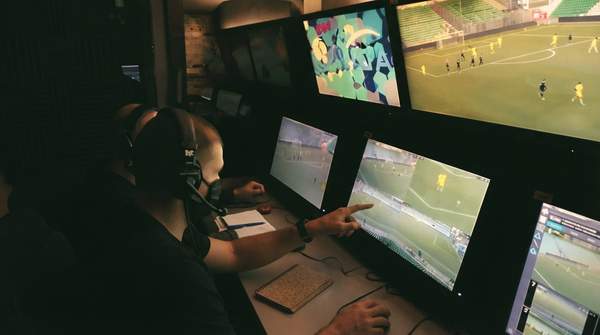
Crucially, the system is proactive rather than reactive. As USA Today explains, VAR is "a team of officials in a control room that is already watching every play and will flag anything a referee misses on the field"—and, as that account puts it, "challenge flags are not needed." The IFAB protocol makes the point explicit: because the VAR automatically "checks" every situation, "there is no need for coaches or players to request a 'check' or 'review,'" and team personnel are prohibited from trying to influence the review process. A player or official who excessively signals for a review can be cautioned; one who enters the video operating room can be sent off.
The referee on the field remains the final authority. When a review concludes, the referee must show the "TV signal," communicate the final decision, and restart play according to the Laws of the Game. IFAB notes there is no maximum time limit for the review process, because some situations involve several reviewable decisions at once. The protocol also states that a match is not, in principle, invalidated by VAR technology malfunctions, wrong decisions involving the VAR, or decisions not to review an incident—because the VAR is itself a match official.
NFL Instant Replay: The Coach's Challenge
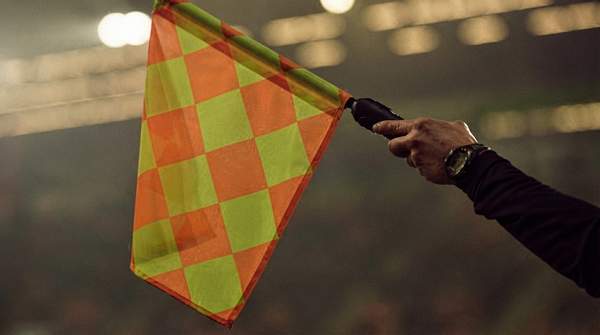
The NFL's system, governed by the league's rulebook under Rule 15 on instant replay, takes a different approach to initiation. Under Article 1 of that rule, as reported by Saad Yousuf of The Athletic in August 2026, "The Head Coach or head coach's pregame challenge designee can initiate a challenge by throwing a red flag onto the field of play before the next legal snap or kick." That season's tweak—allowing a coach to designate a staff member to throw the flag—was a change from the previous requirement that only the head coach could carry and throw the red flag, and it was made through the league's process for adjustments that do not require an owner vote.
The contrast with soccer is stark. In the NFL, the initiative rests partly with a team's sideline: a coach must see a questionable call, decide it is worth challenging, and physically signal for a stoppage before play resumes. In soccer, the initiative rests entirely with the officiating structure itself. The NFL's rulebook is the responsible authority for the full mechanics of its replay system, including what happens when a challenge fails; the specific provisions beyond the initiation rule are set out in that rulebook rather than in the reporting summarized here.
VAR vs. NFL Instant Replay: A Comparative Breakdown
Setting the two systems side by side shows how the same underlying technology—video—produces two different officiating models. The table below juxtaposes them across the dimensions that matter most to a reader trying to explain the difference: where each came from, what each is for, who starts a review, and what each system will look at.
| Feature | Soccer (VAR) | American Football (NFL Instant Replay) |
|---|---|---|
| Historical origin | Written into the Laws of the Game by IFAB on March 3, 2018, as an officiating tool for "greater fairness in football." | Instant replay was invented for television on December 7, 1963, by CBS's Tony Verna for the Army–Navy Game broadcast; the NFL later adapted the technology for officiating. |
| Guiding philosophy | "Minimum interference–maximum benefit": correct only "clear and obvious errors" and "serious missed incidents," conforming to the principles of the Laws of the Game. | Review is initiated from the sideline by a coach's challenge, reflecting a model where teams, not only officials, trigger second looks. |
| Who initiates a review | The VAR team, which automatically checks every situation; coaches and players cannot request a review and must not try to influence the process. The referee makes the final decision. | The head coach, or a pregame challenge designee, throws a red flag onto the field before the next legal snap or kick. |
| Scope of review | Limited to defined match-changing incidents: goals and offside, penalty decisions, direct red cards, and mistaken identity. | Coach-initiated challenges target specific calls on the field; the full scope and consequences are governed by the NFL rulebook's instant replay provisions. |
The pattern that emerges is one of proactive versus reactive design. Soccer built a standing surveillance system: officials in a control room watch every angle of every play, and the referee is told to take another look only when they spot something clearly wrong within the defined categories. The NFL built a contestable-call system: the game's officiating can be questioned by a participant—the coach—who must judge, in real time, whether a call is worth stopping play to dispute.
Understanding the Divergent Paths of Video Review
Readers should recognize that while both VAR and NFL instant replay use video technology, their fundamental design choices reflect distinct priorities regarding game flow, fairness, and the role of officials versus coaches. Soccer's system concentrates authority in the officiating crew and deliberately excludes teams from the process, accepting longer, open-ended reviews in exchange for consistency across a narrow set of incidents. The NFL's system shares authority with the teams themselves, tying review to a visible, time-bound act—the red flag thrown before the next snap. Neither approach is a settled verdict on which sport officiates better; they are answers to the same question, arrived at from different histories and different philosophies of who should be watching the watchers.
The measurable test of whether this comparison is clear is simple: the reader can accurately describe who initiates a review and what types of plays are reviewable in both soccer's VAR and the NFL's instant replay. If you can explain that a soccer review starts with video officials in a control room checking every play for clear and obvious errors in four defined categories, while an NFL challenge starts with a coach—or that coach's designated staff member—throwing a red flag before the next snap, you have grasped the essential difference between the two systems.